
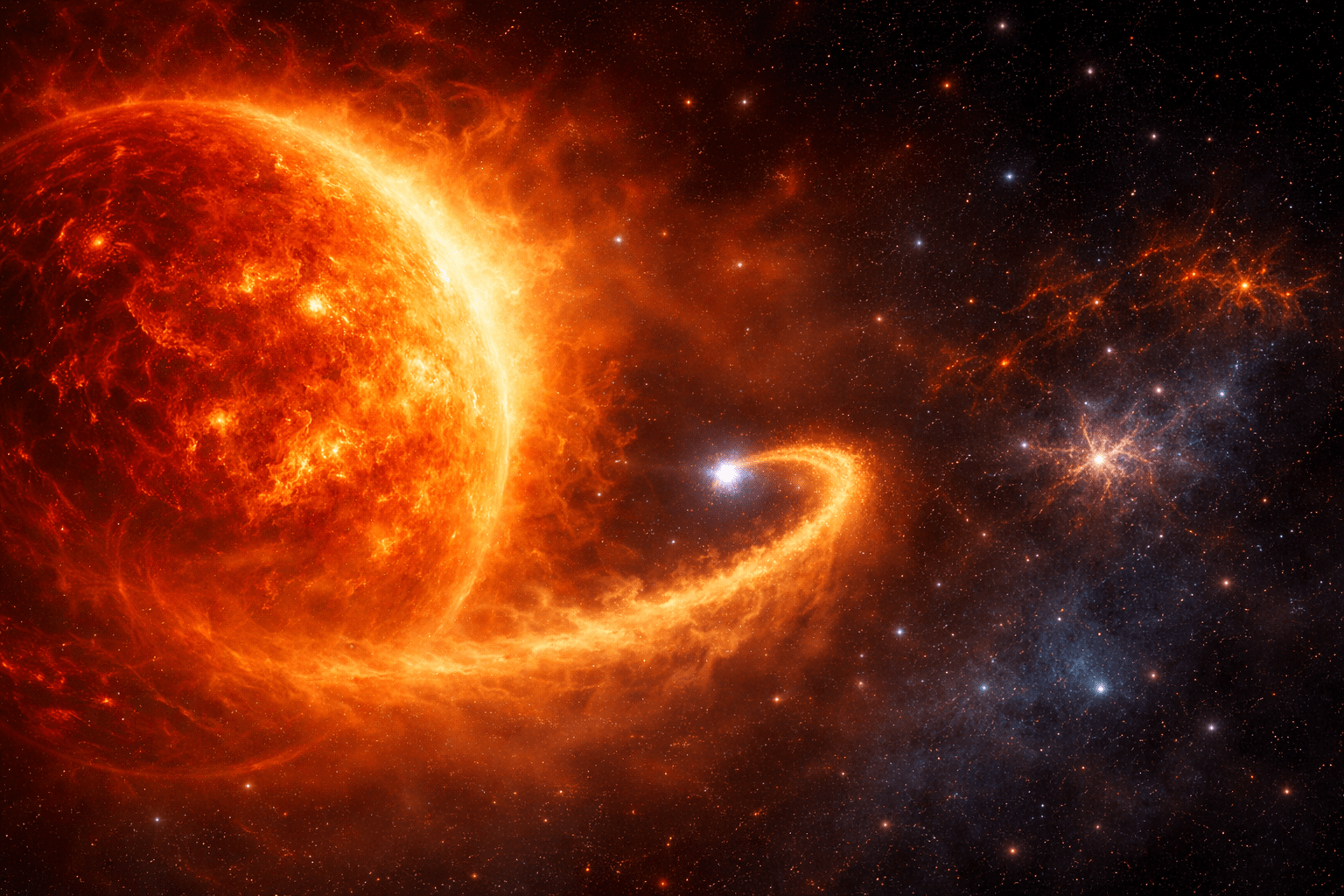
Recently, astronomers discovered a hidden companion star to the red supergiant star Betelgeuse.
Betelgeuse is the brightest star in Orion, located in his right shoulder.
It is very easily seen to be red with the naked eye.
The colour of a star gives us a clue about the stars surface temperature.
Betelgeuse is 3,600 to 3,800 Kelvin (K) (about 6,000°F or 3,300°C).
This star is so huge that if it were where our Sun is, its disk would almost stretch out to Jupiter.
The companion star is called Siwarha, named for its Arabic meaning, “her bracelet,”.
Betelgeuse means “hand of the giant”.
Detected through its “wake” of gas as it orbits Betelgeuse within the larger star’s atmosphere.
Betelgeuse has always been a variable star, but during 2020 into 2021, Betelgeuse’s brightness faded quite a bit.
This caused much excitement and many to speculate that it was just about to go supernova, literally blowing itself apart.
It is true that Betelgeuse is near the end of its life and will go supernova, but whether it’ll blow tomorrow, in the next 300 years, or in another 100,000 years, no one knows for sure.
Mind you, as Betelgeuse lies 500-700 light-years from Earth, we are seeing it as it was all those years ago.
Maybe it’s already popped, and that brighter light is already winging its way towards us…
Speculation aside, the presence of Siwarha may help explain Betelgeuse’s mysterious dimming and pulsation cycles, as it is not a solitary star but part of a binary system. This tiny star, estimated to be about 1.5 times the Sun’s mass, orbits Betelgeuse every ~6 years, which could influence Betelgeuse’s behaviour before its eventual supernova.
This isn’t anythingus amateur astronomers can see or capture in images, but it does make studying Betelgeuse much more interesting.
The Image at the Top. What You’re Seeing
-
Big glowing star: Betelgeuse — A red supergiant hundreds of times wider than the Sun, with a reddish hue.
-
Tiny dot or companion: A much smaller star (Siwarha) orbiting near Betelgeuse’s outer atmosphere; it’s a pinprick in scale compared to the giant.
-
Gas wake/trails: In this AI image, a trail shows how the companion carves through Betelgeuse’s extended atmosphere, like a boat’s wake.
🌟 About the Companion
-
This companion star, Siwarha, was identified through high-resolution imaging and observations showing how it influences Betelgeuse’s light and surrounding gas — leaving a visible wake.
-
It is much fainter and smaller than Betelgeuse, likely a young hot star with only a few times the Sun’s mass.
-
Scientists think this companion helps explain some of Betelgeuse’s mysterious brightness changes.